
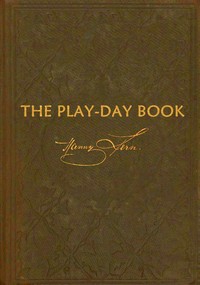
The Play-day Book: New Stories for Little Folks by Fanny Fern
Let's be clear from the start: 'The Play-day Book' is not a novel. Don't pick it up expecting a single, sweeping plot. Instead, think of it as a literary lunchbox, packed with all sorts of little treats. Published in 1871, it's a collection of very short stories, poems, and moral tales aimed squarely at children. Fanny Fern, a massively popular and often controversial newspaper columnist, uses her signature conversational style to talk directly to her young audience.
The Story
There isn't one story, but dozens. One tale might follow a boy who learns the hard way that lying has consequences. Another might paint a picture of a perfect (and probably unrealistic) Sunday for a Victorian family. There are fables about animals, gentle lectures on kindness, and simple poems about the seasons. The 'action' is quiet—a child choosing generosity over selfishness, siblings finding a way to play together, or a lesson learned from observing nature. It's a snapshot of the values and pastimes of its era, where a well-behaved child and a happy home were the ultimate goals.
Why You Should Read It
I'll be honest, some of the morals feel dated. But that's partly why I find it so fascinating. Reading this book is an act of time travel. You get to sit on the rug beside a child from the 1870s and see what the grown-ups wanted them to hear. Beyond the history, Fern's voice is the real star. She's not a distant, scolding author. She writes like a kind, funny aunt who's seen a lot of life and wants to pass on some wisdom, albeit with the sugar-coating of the time. There's a warmth here that cuts through the centuries. You can feel her wanting to engage and entertain, not just instruct.
Final Verdict
This book is a niche gem, but a sweet one. It's perfect for history lovers, fans of vintage children's literature, or writers curious about voice and audience across time. It's not a book you give to a modern 8-year-old for fun (they'd likely find it slow), but it is a wonderful resource for parents or educators to dip into and discuss how ideas about childhood have changed. Think of it less as a storybook and more as a conversation starter, beautifully preserved from the pages of a long-ago newspaper.
This book is widely considered to be in the public domain. Feel free to use it for personal or commercial purposes.
Ava Rodriguez
1 year agoThis is one of those stories where it manages to explain difficult concepts in plain English. Exactly what I needed.
Amanda Young
7 months agoAfter finishing this book, the atmosphere created is totally immersive. Don't hesitate to start reading.
Mark Flores
11 months agoFinally found time to read this!
Oliver King
3 months agoI have to admit, the arguments are well-supported by credible references. I would gladly recommend this title.



Carol Smith
1 year agoHonestly, the author's voice is distinct and makes complex topics easy to digest. I couldn't put it down.