
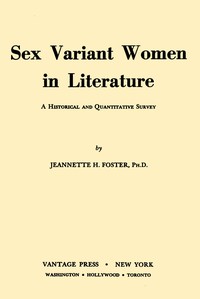
Sex variant women in literature : A historical and quantitative survey by Foster
Jeannette Foster's Sex Variant Women in Literature isn't a novel with a plot in the traditional sense. Think of it more as a massive, carefully organized treasure hunt. Foster, working as a librarian in the mid-20th century, set herself a huge task: to find and document every example of love between women she could find in Western literature, starting with ancient Greek poetry and moving all the way through to the books being published in the 1950s.
The Story
The 'story' is Foster's journey through the stacks. She reads everything—classics, obscure novels, French poetry, popular fiction—and takes notes. She sorts what she finds into different types of stories and characters. Some are tragic, some are villainous, some are subtle hints, and a few are surprisingly positive. The book builds, era by era, showing how writers have depicted (or hidden) relationships between women. The climax isn't a single event, but the accumulated weight of all this evidence, page after page, proving this thread of human experience has been woven into our stories for thousands of years, whether society acknowledged it or not.
Why You Should Read It
Reading this book feels like getting a master key to literary history. It's incredibly empowering. Foster did this work alone, without fanfare, at a time when such a project was radical. You can feel her determination on every page. It’s not just an academic list; it’s a act of recovery and resistance. For anyone interested in LGBTQ+ history, it's a landmark. It shows you where to look and helps you understand the coded language earlier writers had to use. It also makes you appreciate how far we've come in being able to tell these stories openly. It’s a powerful reminder that we have always been here, writing, reading, and loving.
Final Verdict
This is a must-read for anyone curious about the roots of queer literature and the hidden histories within our classic books. It's perfect for history buffs, literature students, and LGBTQ+ readers who want to understand their literary ancestors. Be warned: it's a dense, scholarly work, not a light read. But if you're willing to explore, it's a profoundly rewarding and foundational text. It’s the book that helped map a forgotten continent of stories.
This work has been identified as being free of known copyright restrictions. Feel free to use it for personal or commercial purposes.
Michelle Williams
1 year agoAfter finishing this book, the content flows smoothly from one chapter to the next. One of the best books I've read this year.
George Brown
1 month agoSurprisingly enough, it manages to explain difficult concepts in plain English. I would gladly recommend this title.



Paul Martinez
1 year agoEnjoyed every page.